
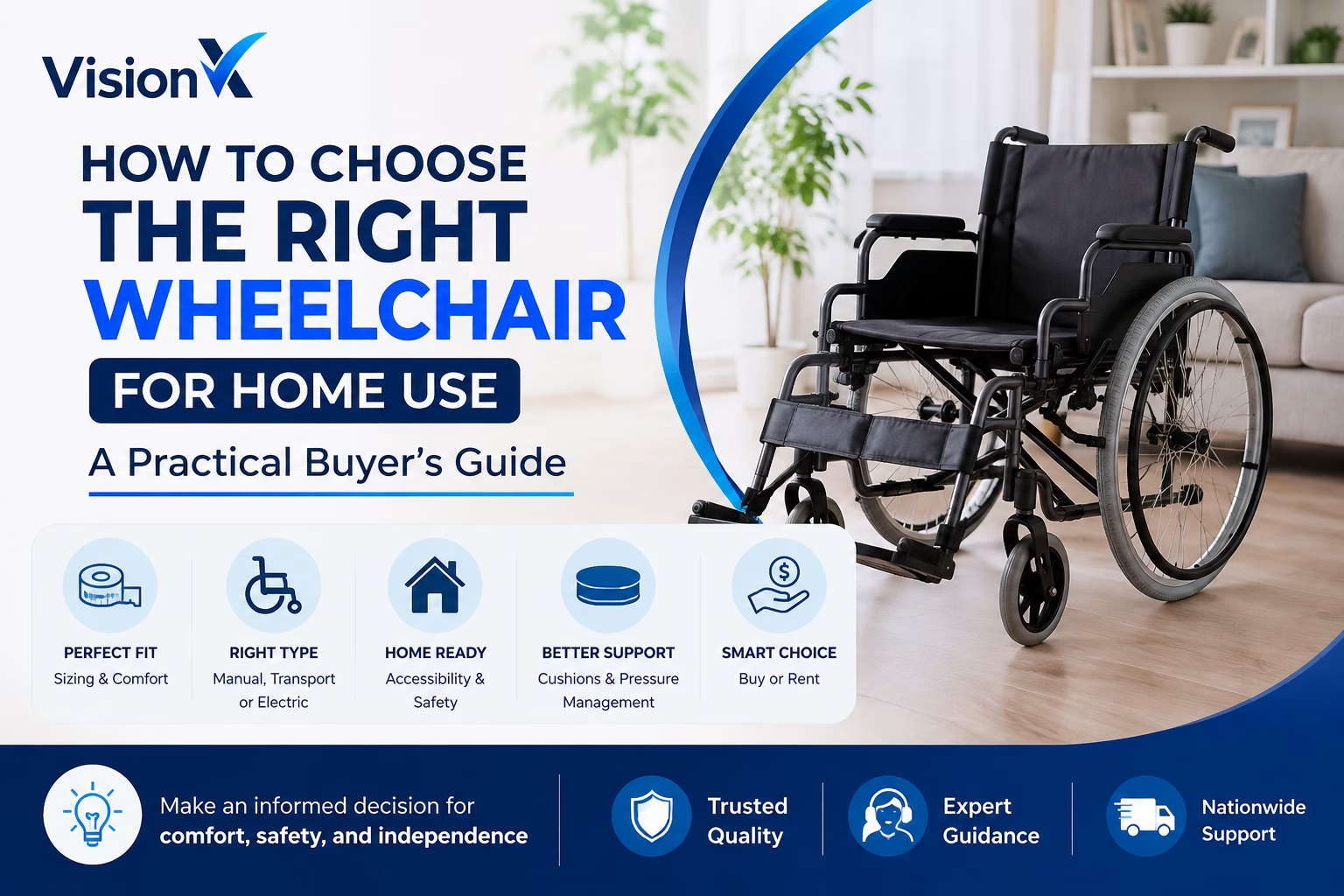
How to Choose the Right Wheelchair for Home Use: A Practical Buyer’s Guide
Choosing a wheelchair for home use is not simply a matter of finding the lowest price or selecting a chair with the most features.
The right wheelchair needs to match the person using it, their mobility and seating needs, who will operate it, how frequently it will be used, and the physical environment in which it will be used.
A wheelchair that works well for one person may be uncomfortable, difficult to maneuver, or unsuitable for another. The World Health Organization (WHO) recommends an individualized process of assessment, fitting, training, and follow-up when providing wheelchairs rather than treating wheelchair selection as a one-size-fits-all purchase.
For home use, there is another important consideration: the wheelchair must also work within the actual layout of the home.
This guide explains what to consider before choosing one.
1. Start With the User’s Functional Needs
Before comparing wheelchair models, start with the person who will use it.
Ask:
- How mobile is the user? Can they walk short distances with or without assistance, or do they rely on a wheelchair for most mobility?
- Who will propel the chair? Can the user safely self-propel, or will a caregiver primarily push it?
- How frequently will it be used? Occasionally, every day, or for most of the day?
- How long will it be required? Is it for temporary recovery or long-term mobility?
- Can the user maintain an upright sitting position? Or do they need additional postural support?
- Where will it be used? Mainly indoors, outdoors, or in both environments?
These questions help determine the appropriate wheelchair category before comparing individual products.
For someone with complex mobility, neurological, postural, or physical needs, professional assessment becomes particularly important. WHO’s wheelchair-provision guidance emphasizes individual assessment before fitting and supplying a wheelchair.
The goal is not to find the “best wheelchair” in general. It is to find the best match for this particular user.
2. Get the Fit and Ergonomics Right
A wheelchair is both a mobility device and a seating system. Its dimensions can affect posture, comfort, propulsion, transfers, and everyday function.
Seat Width
The seat should provide enough room for the user’s body without pressing against the thighs or leaving excessive space.
A practical fitting check is to ensure there is appropriate clearance between the user’s thighs and the sides of the wheelchair without creating pressure.
A seat that is too narrow can create unwanted pressure against the thighs and hips. A seat that is too wide can make positioning and propulsion more difficult.
Rather than applying a universal “add two inches” formula to every person, use the user’s actual body measurements together with the wheelchair’s configuration, cushion, clothing, and posture.
Seat Depth
Seat depth should support the thighs without pressing against the back of the knees.
A practical WHO fitting check is to leave approximately two fingers, or around 30 mm, between the front edge of the seat or cushion and the back of the knee.
Too little depth can reduce thigh support. Too much can create pressure behind the knees and affect sitting posture.
Footrest and Footplate Position
Footrests should support the user’s legs and feet while maintaining appropriate clearance from the ground.
WHO wheelchair fitting guidance uses approximately 5 cm of ground clearance as a practical consideration for footrests.
The exact configuration depends on the user’s leg length, foot position, wheelchair design, and the surfaces over which the chair will travel.
Backrest and Armrests
Backrest height and armrest position should support the user’s posture without unnecessarily restricting movement, propulsion, or transfers.
An active self-propeller may require a different backrest configuration from someone who needs greater trunk support.
For users with significant positioning requirements, professional seating assessment is preferable to relying on generic measurements.
Quick Sizing & Clearance Summary
- Seat Width: Check clearance at the user’s hips and thighs without squeezing or leaving excessive space.
- Seat Depth: Ensure approximately 30 mm (two fingers) of space between the front edge of the seat and the back of the knee (popliteal fold).
- Footrest Clearance: Maintain approximately 5 cm of ground clearance for the footrests or footplates, while considering thresholds and the surfaces the wheelchair will cross.
- Home Clearance: Measure the wheelchair’s total outer width, including the handrims, against the narrowest door frame.
3. Choose the Right Cushion and Consider Pressure Management
A wheelchair cushion is not simply a comfort accessory.
WHO describes wheelchair cushions as serving important functions related to comfort, posture, and pressure redistribution.
Not every wheelchair user requires a specialized pressure-relief cushion, but users who are at risk of pressure injury may need one.
Why Pressure Redistribution Matters
When a person remains seated, pressure is concentrated around areas such as the ischial tuberosities, often called the sitting bones, and the sacrum or tailbone.
A suitable seating system can help redistribute pressure across a larger area and reduce excessive loading at vulnerable points.
Shear is another consideration. Sliding forward in the chair or using an unsuitable seating system can contribute to shear forces and poor positioning.
Foam Cushions
Foam cushions are widely available and can provide comfort, support, and pressure redistribution depending on their design.
They may be appropriate for some users with lower pressure-management needs, but not every foam cushion provides the same level of support or pressure redistribution.
Daily sitting duration should be considered alongside sensation, posture, skin condition, mobility, and the user’s ability to reposition.
Gel and Hybrid Cushions
Gel and hybrid designs can provide different combinations of pressure redistribution, immersion, stability, and positioning.
They may be useful for some users who require additional pressure management or positioning support.
Their suitability depends on the individual rather than simply the material used.
Air-Cell Cushions
Air-cell cushions can provide specialized pressure redistribution for people with particular clinical needs.
They may be considered for users with reduced sensation, previous pressure injuries, or other significant pressure-management requirements.
There is no universal sitting-time threshold that determines which cushion every person needs. Someone sitting for several hours may have very different requirements depending on sensation, skin integrity, posture, ability to reposition, and clinical history.
For users with significant pressure-injury risk, professional seating and pressure-management assessment is appropriate.
Pay Attention to Skin Changes
Users and caregivers should pay attention to:
- Persistent redness
- Skin irritation
- Discomfort
- Numbness
- Changes over bony areas
- Previous or developing pressure injuries
People with reduced sensation may not feel excessive pressure normally.
If there is a history of pressure injury, reduced sensation, significant mobility limitations, or difficulty repositioning, professional seating and pressure-management advice is appropriate.
4. Match the Wheelchair Type to the User
Once the user’s needs and seating requirements are understood, compare the wheelchair categories that may be appropriate.
Manual Wheelchairs
Manual wheelchairs are propelled by the user or by another person.
They may be suitable when:
- The user can safely self-propel.
- A caregiver regularly provides assistance.
- The wheelchair needs to be relatively straightforward to transport.
- Battery charging is unnecessary or undesirable.
Manual wheelchairs range from basic folding models to highly adjustable configurations.
Transport Wheelchairs
Transport wheelchairs are primarily designed for caregiver-assisted mobility.
They can be useful when the user does not need to self-propel and the main requirement is moving between locations with assistance.
They can also be useful when compact transportation is a priority, although the specific model still needs to fit the user and environment.
Electric or Powered Wheelchairs
Powered wheelchairs use motors and batteries to provide mobility.
They may be appropriate for people who cannot effectively self-propel a manual wheelchair or who require powered mobility for greater independence.
However, powered wheelchairs introduce additional considerations:
- Battery charging
- Overall weight
- Transportation
- Storage
- Maintenance
- Controls
- Turning space
- Accessibility of the intended environment
A powered wheelchair is not automatically a better choice simply because it offers more technology.
Reclining, Tilt-in-Space, and Specialized Wheelchairs
Some users require specialized wheelchair configurations for positioning, postural support, transfers, or other functional needs.
Depending on the individual, this may include reclining, tilt-in-space, standing, pediatric, commode, or other specialized designs.
These should be selected because they address a specific requirement rather than because they provide additional features.
WHO emphasizes that wheelchair users have different requirements and that wheelchair provision should be individualized rather than based on a single standard model.
5. Audit the Home Before You Buy
A wheelchair can fit the user well and still be impractical if it cannot move comfortably through the home.
Before purchasing, measure the actual route the wheelchair will need to take.
Measure the Narrowest Doorways
Check:
- Main entrance
- Bedroom doors
- Bathroom doors
- Kitchen entrances
- Other frequently used doorways
Do not measure only the nominal door size.
Compare the narrowest usable opening with the wheelchair’s actual overall width, including wheels, handrims, armrests, and other components that extend beyond the seat.
This is particularly important in compact or older residential layouts where bathroom or bedroom doorways may be narrower than expected.
In some homes in Nepal and elsewhere, narrow doorways can make an otherwise suitable wheelchair impractical.
The practical rule is simple:
Measure the home first, then choose the wheelchair.
Check Hallways and Turning Areas
Consider whether there is enough room to:
- Move along corridors
- Approach doors
- Turn around furniture
- Enter and exit the bathroom
- Approach the bed
- Navigate between commonly used areas
Turning requirements vary by wheelchair and environment, so a single generic turning-radius number should not be treated as a universal requirement for every home.
If a caregiver will accompany the user, also account for the space required by the caregiver.
Check Raised Thresholds
Small changes in floor level can affect wheelchair movement.
Look for:
- Door thresholds
- Raised bathroom entrances
- Marble or stone sills
- Floor transitions
- Thick carpets
- Uneven surfaces
- Slopes
- Ramps
In some Nepali homes, traditional raised door sills, sometimes referred to locally as dhoka ko sanghar, can create an additional obstacle for small front casters.
Where appropriate, a suitable threshold ramp or accessibility modification can make these transitions easier to navigate.
Consider Stairs
A standard wheelchair should not be used to carry a person up or down stairs.
If the home has multiple levels, consider whether the user can access the necessary areas without stairs or whether an appropriate ramp, lift, alternative entrance, or other accessibility solution is required.
Specialized stair-climbing wheelchairs exist, but they should be assessed carefully for the particular user, caregiver, and environment.
6. Consider Tires, Terrain, Caregiver Use, and Transportation
The operational side of wheelchair selection matters just as much as the frame and seat.
Solid and Puncture-Resistant Tires
Solid or puncture-resistant tires can be convenient for users who prioritize low maintenance and predictable performance.
They can work well for many indoor environments and smoother paved surfaces.
Pneumatic Tires
Air-filled pneumatic tires can provide additional shock absorption on uneven surfaces.
They may be useful when the wheelchair regularly travels over rough outdoor terrain, brick paths, gravel, or other uneven surfaces.
The trade-off is that pneumatic tires require pressure maintenance and can be vulnerable to punctures.
The best choice depends on where the wheelchair will actually be used.
Think About the Caregiver
If a caregiver will regularly operate the wheelchair, consider:
- Pushing: Can the caregiver maneuver it comfortably?
- Braking: Can the caregiver easily operate the brakes?
- Folding: Can the chair be folded safely if necessary?
- Lifting: Is the weight manageable?
- Transfers: Does the design allow appropriate access when assisting the user?
- Storage: Can it be stored safely between uses?
A wheelchair that is technically suitable for the user but difficult for the caregiver to handle may not be a practical long-term solution.
Think About Transportation
A wheelchair used at home may still need to travel outside the home.
Before buying, consider whether it needs to:
- Fit inside a car
- Fit into a taxi
- Be folded
- Be carried upstairs
- Be loaded by a caregiver
- Be stored in a small space
For manual wheelchairs, compare both weight and folded dimensions.
For powered wheelchairs, batteries and motors can substantially increase weight and transportation requirements.
Never assume that a wheelchair will fit into a vehicle simply because it is described as “portable.” Check the actual dimensions.
7. Buy or Rent?
The decision to buy or rent should depend on the user’s circumstances rather than a universal number of weeks or months.
Renting May Make Sense When:
- The wheelchair is needed temporarily.
- The user is recovering from an injury or procedure.
- Long-term mobility requirements are uncertain.
- Storage space is limited.
- The family does not expect continued use.
Buying May Make Sense When:
- The wheelchair will be used regularly for an extended period.
- The user has an ongoing mobility requirement.
- A particular configuration is needed.
- The household expects continued use.
- A customized seating solution is required.
When comparing the two options, consider the total cost of use, including:
- Purchase price or rental fees
- Maintenance
- Repairs
- Warranty
- Transportation
- Storage
- Accessories
- Expected duration of use
There is no universal point at which renting becomes cheaper than buying. The answer depends on the rental rate, purchase price, expected duration, servicing, and type of wheelchair.
For families in Nepal considering temporary or long-term mobility support, VisionX can be one resource for exploring wheelchair options and comparing available rental or purchase pathways.
Practical Wheelchair Selection Checklist
| Factor | What to Check & Measure | Practical Question to Ask |
|---|---|---|
| User Needs | Mobility level, independence, trunk control, duration | Who will use the chair and what do they need it to do? |
| Propulsion | Self-propelled (handrims), caregiver push, or powered | Who will actually operate the wheelchair day-to-day? |
| Ergonomic Fit | Width, depth, seat height, footrests, backrest | Does it fit the body without pressure points or slumping? |
| Seating & Cushion | Daily sitting time, sensation, skin integrity | Does the cushion provide appropriate pressure redistribution? |
| Home Accessibility | Narrowest doorway, bathroom access, thresholds, turning area | Can the outer width of the chair pass through all required spaces? |
| Terrain & Tires | Indoor tiles, pavement, brick paths, gravel, uneven surfaces | Are solid or pneumatic tires better suited to the environment? |
| Caregiver Usability | Frame weight, folding ease, brake access, transfers | Can the caregiver lift, fold, push, and operate it safely? |
| Vehicle Transport | Car/taxi space, folded dimensions, weight | Will the wheelchair fit the available transport? |
| Essential Features | Leg rests, reclining, positioning, commode setup | Does each added feature solve a genuine functional need? |
| Maintenance | Replacement parts, tire servicing, battery care | Are spare parts and technical service available? |
| Financial Strategy | Expected recovery timeline versus long-term use | Is short-term rental or permanent purchase more practical? |
| Clinical Assessment | Postural needs, sensory loss, pressure concerns | Does the user require professional seating assessment? |
When Should You Seek Professional Assessment?
Not every wheelchair purchase requires the same level of clinical assessment.
For a straightforward, temporary mobility requirement, families may be able to compare basic options using the factors in this guide.
Professional assessment becomes particularly valuable when the user:
- Has significant postural needs
- Has a neurological or musculoskeletal condition
- Cannot maintain an upright sitting position independently
- Has complex mobility requirements
- Will use the wheelchair long term
- Has reduced sensation
- Has a history of pressure injury
- Has difficulty operating a manual or powered wheelchair
WHO’s wheelchair-provision framework is built around four connected stages:
Select → Fit → Train → Follow Up
The process begins by understanding the individual’s needs and selecting an appropriate wheelchair. The chair and cushion are then fitted to the user, followed by training and appropriate follow-up.
This matters because buying the right model is only part of successful wheelchair provision.
The user also needs to know how to operate it safely, and caregivers may need training in braking, transfers, folding, maintenance, and other aspects of day-to-day use.
Final Thoughts
Choosing the right wheelchair is ultimately about finding the right match between the person, the wheelchair, and the environment.
Start with the user’s mobility and daily requirements. Then consider fit, seating, pressure management, wheelchair type, home accessibility, tires, caregiver needs, transportation, maintenance, and cost.
Don’t choose a wheelchair simply because it has the most features or the lowest price.
The better question is:
Can this wheelchair provide the mobility, support, comfort, and practicality this particular person needs in their everyday environment?
For people with straightforward temporary needs, comparing these factors can help narrow down the available options.
For people with complex or long-term mobility requirements, professional assessment, fitting, training, and follow-up can make an important difference.
For readers in Nepal comparing wheelchair options, the VisionX wheelchair category provides a starting point for exploring different wheelchair configurations and models, while VisionX’s rental and purchase pathways can be considered according to the expected duration of use.
This article is intended for general educational purposes and does not replace an individual assessment or advice from a qualified healthcare or rehabilitation professional.